Essential Eight: Remediation & Implementation

ASD Essential Eight Framework
All Work Performed In-House
Over 30 Years Experience
Trusted by Australian Organisations
8
Strategies. We implement all of them.
Risk-first
Remediation sequenced by impact, not alphabetical order
In-house
All technical work done by AusCi — no subcontractors
ML1 → ML3
We take you to whatever level your business needs

What Is Essential Eight Remediation?

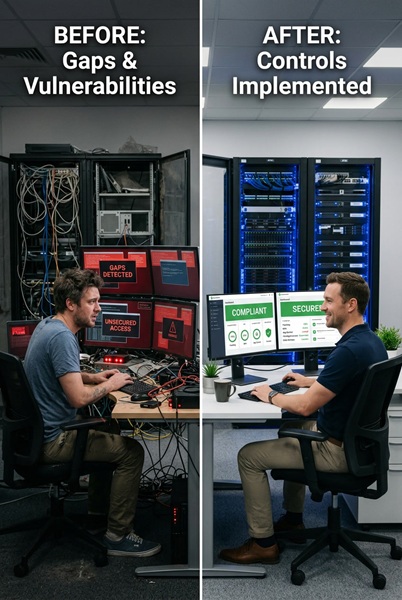
Remediation is the technical implementation work that closes the gaps identified in your Essential Eight Gap Assessment or your Essential 8 Maturity Level Assessment. It’s the difference between knowing you have weak application control and actually having strong application control.

Remediation isn’t a single task — it’s a structured program of work across your environment. Depending on your starting point and target maturity level, it might include:

– Deploying and configuring application allow listing
– Implementing phishing-resistant MFA across all systems
– Hardening Microsoft Office macro settings via Group Policy
– Patching operating systems and third-party applications to compliance
– Restricting and auditing administrative privileges
– Configuring immutable, offline backup systems
– User application hardening — disabling legacy plugins, scripts, and features

We scope, sequence, and implement all of it. Your team keeps running your business.

What Is Essential Eight Remediation

Why Remediation Order Matters

Not all gaps are equal. A business with no MFA on remote access and outdated OS patches faces a completely different risk profile than one that’s fully patched but has loose admin privileges. Fixing things in the wrong order wastes money and leaves your highest-risk gaps open longest.

Our remediation programs are always sequenced by risk — highest impact, lowest effort first — so you get the most meaningful protection at each stage, not just a to-do list worked through alphabetically.

Application Control

Deploy and maintain application allowlisting across workstations and servers. Block unapproved executables, libraries, scripts, and drivers — not just .exe files.

Patch Management

Implement automated patching workflows. Critical vulnerabilities addressed within 48 hours. Full patch compliance reporting for your records.

Microsoft Office Macro Hardening

Configure Group Policy to block macros from internet sources. Enable only digitally signed macros from trusted publishers for users with genuine business need.

User Application Hardening

Disable Flash, Java, legacy browser plugins, and automatic script execution. Harden web browsers and Office applications against exploitation.

Privileged Access Management

Audit and restrict administrative privileges. Implement separate admin accounts, remove standing admin rights, and deploy Privileged Access Workstations (ML3).

Multi-Factor Authentication

Roll out MFA across remote access, internet-facing services, and privileged accounts. Implement phishing-resistant FIDO2/passkeys where ML3 is required.

Operating System Patching

Establish patch compliance across all OS environments. Isolate or replace end-of-life systems. Automate OS patching with compliance monitoring.

Backup & Recovery

Design and implement backup systems that meet ACSC criteria — immutable storage, offline copies, minimum 3-month retention, and regular restoration testing.

Free to start

Close the Gaps. Verify the Level.

Whether you’re starting from a fresh gap assessment or picking up from one done elsewhere, we can scope a remediation program for your environment. All work done in-house. No surprises.

How a Remediation Engagement Works

Step 1 — Remediation Scoping

We review your gap assessment findings (ours or another firm’s) and build a scoped remediation plan. Scope includes: which systems, which users, which maturity level targets, timeline, and dependencies. Fixed-scope engagements mean no surprise invoices.

Risk-Prioritised Sequencing

We sequence work by risk impact. Your highest-exposure gaps — typically MFA, privileged access, and OS patching — are addressed first. Lower-risk items follow once your attack surface is materially reduced.

Technical Implementation

Our engineers implement controls directly in your environment. We work in windows that minimise business disruption — after hours where needed, staged rollouts for business-critical systems. All changes documented.

Step 4 — Validation Testing

Each implemented control is tested to verify it works as designed. Application control that looks configured but doesn’t block unapproved software isn’t remediation — it’s theatre. We test everything we implement.

Step 5 — Handover & Documentation

You receive full documentation of implemented controls, configuration records, and operational runbooks so your team can maintain them. Nothing is left as a black box.

Step 6 — Optional: Maturity Verification

Once remediation is complete, we can proceed directly to a formal maturity assessment to verify your new level — closing the loop from gap to verified compliance.

What You Receive

Our commitment to quality workmanship and our friendly customer service sets us apart from the competition.

  • Scoped remediation plan with timeline and milestones
  • Risk-prioritised implementation sequence
  • All technical implementation work (in-house, no subcontractors)
  • Validation testing for each implemented control
  • Full configuration documentation and change records
  • Operational runbooks for ongoing maintenance
  • Handover session with your IT team
  • Optional: maturity assessment to formally verify the outcome

We Work With Your Environment

Microsoft Environments

Most of our SMB clients run Microsoft 365, Entra ID, and Windows endpoints. The Essential Eight was designed with this stack in mind — we know it well.

 Cloud & Hybrid

Whether you’re fully cloud, hybrid, or still on-premise, we scope remediation to your actual environment. Controls implemented where your data actually lives.

No Internal IT? No Problem.

Many of our clients have no dedicated IT staff. We manage the implementation end-to-end, and hand over with enough documentation that it’s maintainable going forward.

Frequently Asked Questions

Scroll to Top