
Essential Eight: Remediation & Implementation
Finding the gaps is the easy part. Closing them — without breaking things, disrupting your team, or blowing the budget — is where most businesses get stuck. That’s exactly what we do.

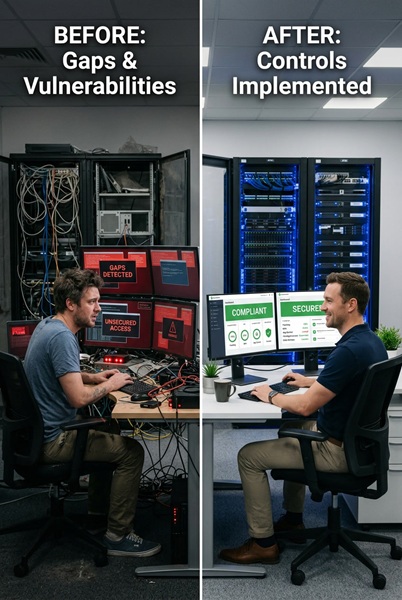
Not all gaps are equal. A business with no MFA on remote access and outdated OS patches faces a completely different risk profile than one that’s fully patched but has loose admin privileges. Fixing things in the wrong order wastes money and leaves your highest-risk gaps open longest.
Our remediation programs are always sequenced by risk — highest impact, lowest effort first — so you get the most meaningful protection at each stage, not just a to-do list worked through alphabetically.
Close the Gaps. Verify the Level.
Whether you’re starting from a fresh gap assessment or picking up from one done elsewhere, we can scope a remediation program for your environment. All work done in-house. No surprises.
How a Remediation Engagement Works
Step 1 — Remediation Scoping
We review your gap assessment findings (ours or another firm’s) and build a scoped remediation plan. Scope includes: which systems, which users, which maturity level targets, timeline, and dependencies. Fixed-scope engagements mean no surprise invoices.
Risk-Prioritised Sequencing
We sequence work by risk impact. Your highest-exposure gaps — typically MFA, privileged access, and OS patching — are addressed first. Lower-risk items follow once your attack surface is materially reduced.
Technical Implementation
Our engineers implement controls directly in your environment. We work in windows that minimise business disruption — after hours where needed, staged rollouts for business-critical systems. All changes documented.
Step 4 — Validation Testing
Each implemented control is tested to verify it works as designed. Application control that looks configured but doesn’t block unapproved software isn’t remediation — it’s theatre. We test everything we implement.
Step 5 — Handover & Documentation
You receive full documentation of implemented controls, configuration records, and operational runbooks so your team can maintain them. Nothing is left as a black box.
Step 6 — Optional: Maturity Verification
Once remediation is complete, we can proceed directly to a formal maturity assessment to verify your new level — closing the loop from gap to verified compliance.
- Scoped remediation plan with timeline and milestones
- Risk-prioritised implementation sequence
- All technical implementation work (in-house, no subcontractors)
- Validation testing for each implemented control
- Full configuration documentation and change records
- Operational runbooks for ongoing maintenance
- Handover session with your IT team
- Optional: maturity assessment to formally verify the outcome